-

- Forums
- Chatrooms
- Gallery
- Gameplay Videos
- Upload
- Articles
- Mod Reviews
- Shop SP: Games, Movies, Books
I'm sure most of you have heard about Baldur's Gate by now since the game has been released more than two years ago (if you haven't, read about it below) but you might not be aware of exactly how big its impact on the whole computer role playing genre was.
Its timing was perfect- at the time it hit the store shelves good CRPGs (computer role-playing games) were rare to say the least and the situation didn't seem to be improving in any way. Black Isle's Fallout was a great success but the fact that it was set in a post-nuclear world might not have been appealing to the audience used to the »swords & sorcery« type of RPGs, no matter how good a game it was. Blizzard's Diablo was another example- it was a great action-packed game but could be called a quasi-role playing game at best. You could say that hard-core AD&D fans were waiting for a game that would restore the genre's former glory and make RPGs popular again and in the opinion of many, only a good AD&D based game could do that.
Here's where Baldur's Gate comes in. It is a classical role playing game set in the Forgotten Realms (Sword Coast to be exact). The game uses second edition AD&D rules with minor modifications for the sake of gameplay but is -all in all- as true to the ruleset as possible.
This was probably one of the reasons for its huge success, since at the time there weren't many good RPGs set in the Forgotten Realms to choose from (at least not new ones) and the fans were probably fed up with Gold Box hits that kept appearing in new collections but failed to deliver anything new for the gamer (unless he/she played the games again for the sake of nostalgia).
BioWare (the people who created Baldur's Gate for Interplay) however, have made the game a very different experience for the gamer used to the old SSI's first-person RPGs like Bard's Tale and Pool of Radiance. Probably the biggest difference from the »oldies« is that now you can also play with your friends over a LAN or over the Internet and journey through the exciting areas of the game together, help each other out fighting monsters and solving quests or (if this is your cup of tea) kill them when they least expect it, but this strategy won't make you very popular among the players who don't share your way of looking at things (remember Diablo?).
Baldurs Gate has won many awards (from Best RPG of the year to Game of the Year). Great graphics, a huge world and hours of play set a new level for RPG gaming which other companies have been striving to achieve ever since. Read why below.
The Game in Brief - What You can Look Forward to with Baldur's Gate
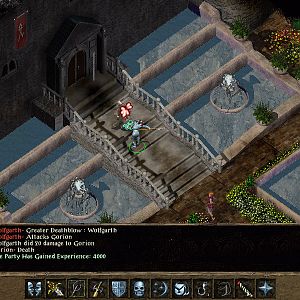
The game is fast paced: action is always happening in the battles. Seen from above in an isometric view, spell casters fire off fireballs with impressive smoke and thunderous explosions, generating real-time lighting effects across the ground and eliciting screams from injured characters.
Bowmen shoot arrows that streak to their targets with a solid "thunk." Fighters race to the front lines and hew their way into the foe with their actual weapons and armor visibly donned by the characters on-screen. Thieves creep in the shadows and emerge to strike from behind.
The gameplay is more faithful to AD&D than any other computer game before it. All facets of the original rules are there: the weapon damage, speed factors for various weapons and spells, and the effects of character ability scores on behavior; charisma will affect how characters in the party behave to the leader as well as morale in combat and interactions with other characters.
The monsters and characters are fully rendered bitmaps which accurately represent the armor and equipment carried by each. The monsters will be as frightful as in any of Geiger's or Brom's works - they will inspire terror in the player (and his party!).
Dialogue is witty and humorous. The characters in the party have believable, consistent personalities and will interact with each other. They critique the leader's actions, comment on the scenery, pick fights with each other, make passes at members of the opposite sex, and add to a character's understanding of the game story and world.
When the combat is finished and the booty is collected, the characters traverse a beautiful landscape, fully rendered in 16-bit color - no tiling done here. As time passes, day turns into night and the area visible becomes the dark blue of night - unless members of the character's party have infravision (which shows enemies and key items as red) or if a light source is available.
Trees and mountains, lakes and streams are all beautifully rendered. Cities are equally impressive. Every building is modeled and rendered in fine detail. There are taverns, temples, houses, stores and fortresses. The alleys in the seedier parts of town are dens of intrigue - dimly lit, with thieves wandering around waylaying unsuspecting travelers, and clandestine deals being made in the dark passages.
A Short Story Synopsis
The story takes place in TSR's best-selling FORGOTTEN REALMS. The western shore along the Sea of Swords contains a multitude of ecologies and terrain including mountains, forests, swamps, marshes, plains, cities, and ruins. Collectively called the Sword Coast, it attracts adventurers and evil alike, and provides the backdrop for this epic adventure. The region encompassed by this game is roughly bordered to the South by the Cloud Peaks, the East by the Wood of Sharp Teeth, the West by the Sea of Swords, and the North by Baldur's Gate (the largest and most affluent city in the region).
Chaos threatens to overwhelm the Sword Coast. The state of Amn is under siege to the south, the High Moor is being overrun in the north, and the region around Baldur's Gate is in turmoil. In an area known for its ample resources, a crippling shortage is slowly developing for the metal that is used throughout the Realms for everything from swords to forks - iron. When iron ore reaching the region is smelted, the resulting wares are plagued with brittleness such that they crack and break with little more than normal use.
What's worse, trading caravans coming from all directions into Baldur's Gate are under constant attack from bandits and cutthroats who loot not for gold and gems (although they often take those too), but for iron. The armed factions in Baldur's Gate can scarcely keep themselves equipped and the commoners are suffering all the more. Without iron they cannot mend their tools or purchase plows - and everyone knows that if they cannot farm or craft, they will starve come winter. Some blame Amn for the chaos, others the trading cartels, and still others suspect even the Dukes of Baldur's Gate. Yet, this contagion may be an early omen of some greater evil...
The player begins the game with one character. This character can be generated using any of the races, classes, and alignments allowed by ADVANCED DUNGEONS AND DRAGONS®. Up to five other adventurers may join the central character as the epic quest proceeds. The player starts in the glorious castle of Candlekeep, an orphan seeking self-knowledge. Although once a solid coastal fortress, Candlekeep is now a great library filled with endless dusty tomes and recluse sages. The player is led out of the keep by a mentor into the wilds of the Sword Coast, and the adventure begins...
|
System Specs |
||
|
|
Required |
Recommended |
|
Processor |
Pentium® 166 |
Pentium® 200 MMX or faster |
|
Operating System |
Window®95 or Window®98 with DirectX 5 or higher |
|
|
RAM |
16 MB |
32 MB |
|
CD-ROM Drive |
4 X |
8 X |
|
Sound Card |
DirectX certified sound card |
|
|
Hard Disk Installation |
300 MB |
600 MB |
|
Video Card |
DirectX certified video card with at least 2 MB of video RAM |
DirectX certified video card with at least 4 MB of video RAM |
|
Multiplayer |
IPX and TCP/IP LAN, or Modem TCP/IP Internet Connection |
Modem-to-modem and serial (null modem) connections |